
Introduction
A relay module is one of the most important electronic components used in Arduino, IoT, and home automation projects. It allows a low-voltage device like a microcontroller to control high-voltage appliances such as bulbs, fans, motors, and pumps safely.
Many beginners damage relay modules because they do not understand how a relay works or how it should be connected. In this guide, you will learn what a relay module is, how it works, where it is used, and the most common mistakes you should avoid.
What Is a Relay Module?
A relay module is an electrically operated switch. It uses a small control signal (usually 5V from Arduino or microcontrollers) to turn ON or OFF a high-power circuit.
Unlike normal switches that are operated manually, a relay switches automatically when it receives an electrical signal. This makes it very useful in automation projects.
Why Do We Need a Relay Module?
Microcontrollers like Arduino work on low voltage (5V or 3.3V) and cannot directly control high-voltage devices such as:
- 230V AC bulbs
- Fans
- Water pumps
- High-current motors
A relay module acts as a bridge between low voltage and high voltage, while keeping the control circuit electrically isolated and safe.
How Does a Relay Module Work?
A relay module mainly has two sections:
1. Control Side (Low Voltage)
- Controlled by Arduino or any microcontroller
- Uses 5V or 3.3V signal
- Activates the relay coil
2. Load Side (High Voltage)
- Connects to external devices like bulbs or motors
- Can handle AC or DC loads
Working Principle:
- A signal is sent from Arduino to the relay input pin
- The relay coil gets energized
- Internal switch changes its position
- The connected appliance turns ON or OFF
When the signal is removed, the relay returns to its original state.
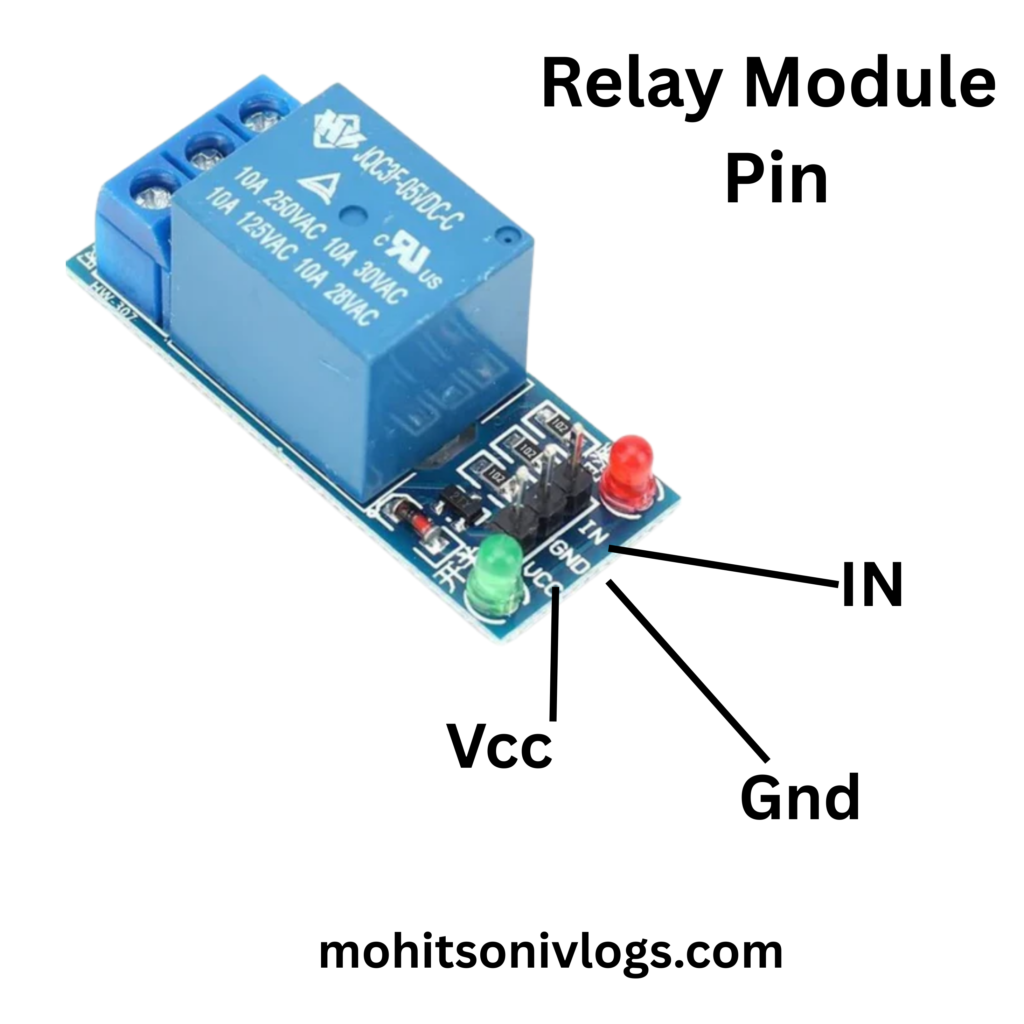
Relay Module Pin Description
Most single-channel relay modules have the following pins:
Control Pins:
- VCC – Power supply (usually 5V)
- GND – Ground
- IN – Control signal from Arduino
Load Pins:
- COM (Common) – Common connection
- NO (Normally Open) – Device is OFF by default
- NC (Normally Closed) – Device is ON by default
Types of Relay Modules
1. Single Channel Relay
- Controls one device
- Best for beginners
2. Multi-Channel Relay (2, 4, 8 Channel)
- Controls multiple devices
- Used in home automation
3. Solid State Relay (SSR)
- No mechanical parts
- Faster and silent operation
- Used in industrial applications
Applications of Relay Module
Relay modules are used in many real-life projects, such as:
- Home automation systems
- Smart switches
- Motor control circuits
- Water pump automation
- IoT projects
- Industrial control systems
Relay Module with Arduino (Basic Idea)
To use a relay module with Arduino:
- Connect VCC to 5V
- Connect GND to GND
- Connect IN to any digital pin
- Write a simple program to control ON/OFF
This setup allows Arduino to control high-power devices safely.
Common Mistakes Beginners Make (Very Important ⚠️)
❌ 1. Connecting AC Voltage Without Safety
Never touch or test 230V AC connections without proper insulation and safety measures.
❌ 2. Using Breadboard for High Voltage
Breadboards are NOT safe for high-voltage AC connections.
❌ 3. Wrong Power Supply
Using unstable or low-quality power supply can cause relay malfunction.
❌ 4. Ignoring Load Ratings
Always check voltage and current ratings of the relay before connecting a device.
❌ 5. No Isolation Awareness
Even though relay provides isolation, poor wiring can still be dangerous.
Relay Module Price in India
Approximate prices (may vary):
4 Channel Relay Module: ₹200 – ₹350
Single Channel Relay Module: ₹70 – ₹120
2 Channel Relay Module: ₹120 – ₹200
Advantages of Relay Module
✔ Easy to use
✔ Provides electrical isolation
✔ Safe control of high-voltage devices
✔ Works with Arduino, ESP8266, ESP32
Limitations of Relay Module
❌ Mechanical wear over time
❌ Slower than solid-state relays
❌ Produces clicking sound
FAQs
Q1. Can I use a relay module without Arduino?
Yes, you can control it using any microcontroller or suitable control circuit.
Q2. Is a relay safe for home automation?
Yes, if used correctly with proper wiring and protection.
Q3. Can relay control both AC and DC loads?
Yes, depending on its rating.
Conclusion
A relay module is a powerful and essential component for beginners in electronics and automation. Understanding its working, proper wiring, and safety precautions is very important before using it in real projects. When used correctly, a relay module allows you to safely control high-voltage devices using low-voltage electronics.